
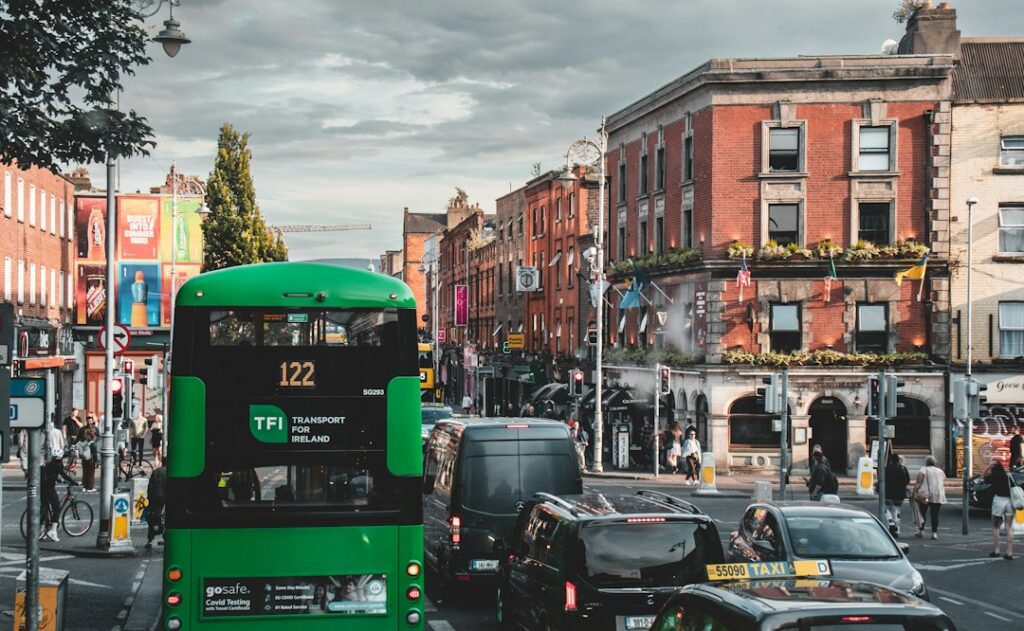
Many newcomers to Dublin wonder if they need a car. The short answer: you probably don’t. Dublin has an extensive public transport network, and between buses, the Luas tram, DART trains, and bike-sharing schemes, you can get almost anywhere in the city and surrounding counties without driving. In fact, owning a car in Dublin can be expensive and stressful — parking is scarce and costly, and traffic congestion is a daily reality.
Here’s how to navigate Dublin’s public transport system as a newcomer, including costs, routes, and practical tips to make your commute easier.
Free Ireland Move Checklist (PDF)
The 40 things to sort before you go, in one list you can tick off.
Send me the free checklistUnderstanding Dublin’s Public Transport Network
Dublin’s public transport is managed by several operators under the Transport for Ireland (TFI) brand. The main services you’ll use are:
- Dublin Bus: The city’s main bus network, covering Dublin and some nearby towns. Routes run frequently during the day, with reduced service in the evenings and on Sundays.
- Luas: Dublin’s light rail tram system, with two lines — the Green Line (running from Bride’s Glen in the south to Broombridge in the north) and the Red Line (running from Tallaght and Saggart in the southwest to The Point in the docklands).
- DART (Dublin Area Rapid Transit): A commuter rail line running along the coast from Howth and Malahide in the north to Greystones in the south, passing through the city center. It’s fast, reliable, and scenic.
- Commuter trains: Irish Rail operates trains to towns outside Dublin, including Drogheda, Dundalk, Maynooth, and Kildare.
All of these services accept the Leap card, a rechargeable smart card that offers discounted fares and works across buses, trams, and trains.
Getting a Leap Card and Understanding Fares
Your first step is to get a Leap card. You can buy one at most convenience stores (look for the Leap card logo), at ticket machines in DART and Luas stations, or online at leapcard.ie. The card itself costs around $6.50 (€5), and you can load it with credit or buy weekly or monthly travel passes.
Fares vary depending on the mode of transport and distance traveled, but here are typical costs:
- Single bus journey (Dublin Bus): Around $2.80–$4 (€2.15–€3.10) depending on distance, or around $1.70–$2.60 (€1.35–€2.05) with a Leap card.
- Single Luas journey: Around $2.60–$4.40 (€2–€3.40) depending on zones, or around $2–$3.50 (€1.54–€2.71) with Leap.
- Single DART journey: Around $2.60–$6.50 (€2–€5) depending on distance, or around $2–$5 (€1.54–€3.86) with Leap.
If you’re commuting daily, a 30-day pass can save you money. A bus-only pass costs around $155 (€120), while an all-zone pass covering buses, Luas, and DART costs around $195 (€150).
One important tip: always tap on and tap off with your Leap card, especially on DART and Luas. If you forget to tap off, you’ll be charged the maximum fare for that journey.
Navigating Routes and Journey Planning
The best tool for planning journeys is the Transport for Ireland (TFI) app or website (transportforireland.ie). It shows real-time arrivals, route maps, and step-by-step directions across all modes of transport. Google Maps also works well for Dublin public transport.
Here are a few tips for getting around:
- Buses can be slow: Dublin traffic is heavy, especially during rush hour (roughly 7:30–9:30 a.m. and 5–7 p.m.). Budget extra time for bus journeys, and check the real-time app to avoid long waits.
- The Luas is reliable: Trams run every few minutes during peak times and are generally on schedule. The Green and Red lines don’t connect directly — you’ll need to transfer at certain stops or use a bus to switch lines.
- The DART is your friend: If you live near the coast (Howth, Clontarf, Sandymount, Dún Laoghaire, Bray), the DART is fast, frequent, and scenic. It’s one of the best ways to commute into the city center.
- Night buses exist: Dublin Bus operates a limited night service on weekends, with routes running roughly every 30–60 minutes from around midnight to 4 a.m. Fares are slightly higher.
Bikes, Scooters, and Walking
Dublin is increasingly bike-friendly, with dedicated cycle lanes expanding across the city. The Dublin Bikes scheme (dublinbikes.ie) offers short-term bike rentals from docking stations all over the city center. An annual subscription costs around $32 (€25), and the first 30 minutes of each journey is free. After that, you pay a small fee per half hour.
You can also use e-scooter rental services like Lime and Tier, which are available via smartphone apps. Scooters cost around $1.30 (€1) to unlock, plus around $0.25 (€0.20) per minute.
Dublin’s city center is compact and very walkable. Many people walk between neighborhoods like Temple Bar, Trinity College, St. Stephen’s Green, and the Docklands, especially during the day.
Living Outside Dublin: Commuter Towns
If you’re living in a commuter town like Maynooth, Bray, Drogheda, or Skerries, you’ll likely rely on Irish Rail commuter trains. These towns are well-connected to the city center, with trains running frequently during the week. A monthly commuter ticket from Maynooth to Dublin, for example, costs around $260 (€200).
Check the Irish Rail website (irishrail.ie) for timetables and fares, and consider a combined Leap card pass if you’ll also be using Dublin Bus or Luas once you reach the city.
Final Thoughts
Getting around Dublin without a car is not only possible — it’s often easier and cheaper than driving. With a Leap card, the TFI app, and a little patience during rush hour, you’ll be navigating the city like a local in no time.
Want more practical tips for settling into life in Ireland? Subscribe to the How To Move To Ireland newsletter — one actionable step a day to help you plan, move, and thrive.