
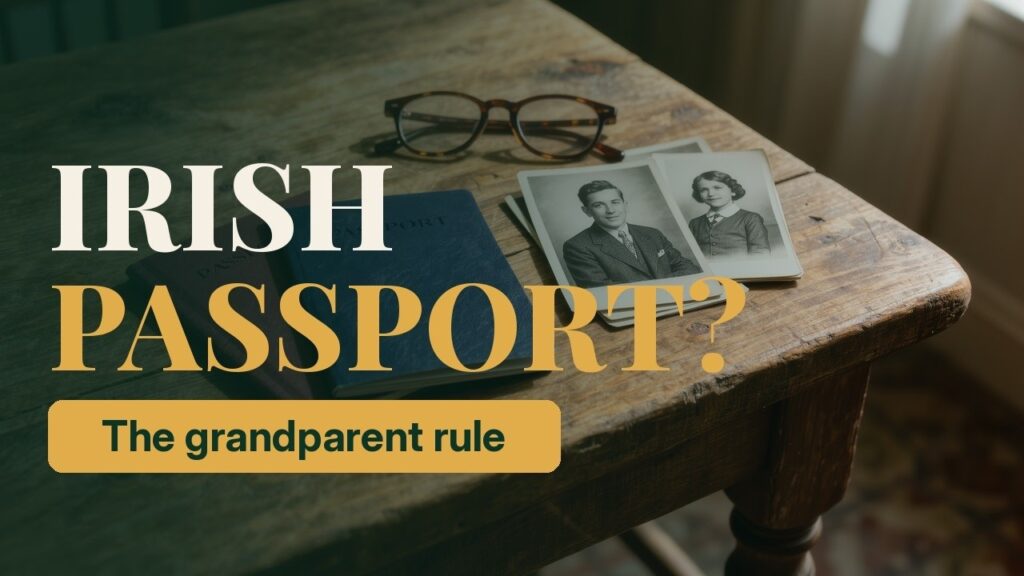
If one of your grandparents was born in Ireland, you may be entitled to Irish citizenship, and with it an Irish passport. Our new video explains the rule in a few minutes. The written version is below, with the costs, the documents and the mistakes to avoid.
Who qualifies: find your situation
| Your connection to Ireland | What it means |
|---|---|
| A parent born in Ireland | You are already an Irish citizen. You can apply for a passport directly. |
| A grandparent born in Ireland, and your parent was born abroad | You can become a citizen by registering on the Foreign Births Register. |
| A great-grandparent born in Ireland | You qualify only if your own parent was on the Foreign Births Register before you were born. |
| An Irish surname, or an earlier ancestor only | You do not qualify by descent. |
“Born in Ireland” means born anywhere on the island of Ireland, including Northern Ireland. What counts is where your grandparent was born. It is not where they lived later, and it is not your family name.
How the grandparent route works
You apply to be entered on the Foreign Births Register, which is run by the Department of Foreign Affairs. The steps are:
- Gather the certificates listed below. This is the slow part.
- Complete the online application and pay the fee.
- Print the form and sign it in front of a witness from one of the professions the Department accepts. The witness also signs two of your four passport photos.
- Post the form, the photos and your original documents.
- Wait for your Foreign Birth Registration certificate. You are an Irish citizen from the date on it.
The documents you need
The Department asks for original civil certificates. Church baptism records and plain photocopies are not accepted.
- For you: your civil birth certificate showing your parents’ details, your marriage certificate if your name has changed, a certified copy of your photo ID, two proofs of address and four passport photos.
- For your parent: their civil birth certificate, their marriage certificate if it applies, and a certified copy of their ID or death certificate.
- For your Irish-born grandparent: their civil birth certificate, their marriage certificate if it applies, and a certified copy of their ID or death certificate.
The grandparent’s Irish birth certificate is usually the hardest to find. Start at IrishGenealogy.ie, the free state-run website, which has civil birth records from 1864 to 1924 with images of the original entries. Search by townland or parish as well as by name, and try different spellings of the surname.
What it costs and how long it takes
- Foreign Births Register fee: €278 for an adult, €153 for a child under 18.
- Processing time: about 12 months. Applications are handled in date order.
- First Irish passport afterwards: €75, plus €15 postage if you live outside Ireland.
Ireland allows dual citizenship, so you do not give up your current passport.
The timing rule that catches families out
Citizenship through the Foreign Births Register starts on the day you are registered. It does not reach back to your birth. That matters for your children: a child can claim through you only if you were already registered when that child was born. If you want your future children to be Irish citizens, register first.
Common mistakes
- Sending church records in place of civil certificates.
- Sending photocopies where originals are required.
- Using a witness who is not in an accepted profession.
- Leaving out the marriage certificates that explain a change of surname between generations.
- Putting off the application. The queue is date-ordered and about a year long.
Where to go next
We send short, practical emails on citizenship, costs and settling in Ireland. Join the free Love Ireland letter here.
If you are still searching for your grandparent’s record, our paid guide 25 Questions & Answers on Tracing Your Irish Ancestors goes much deeper. And once you know you can live in Ireland, Is Moving to Ireland Right for You? covers work, housing, healthcare and costs. Both are part of the paid Love Ireland library on Substack.
This article is general information, not legal advice, and was correct as of October 2026. Fees and waiting times change, so check the official pages before you apply: Registering a foreign birth (Department of Foreign Affairs) and Irish citizenship through birth or descent (Citizens Information).